EMRTS leaders 'Give to Gain' on International Women's Day
International Women’s Day 2026 theme is ‘Give to Gain’, which emphasizes the power of reciprocity and support. Through knowledge, education, training or mentoring, EMRTS female leaders contribution to both women’s and men’s advancement, help drive the service forward and contribute to gender equality.
After all, when we give – we gain!
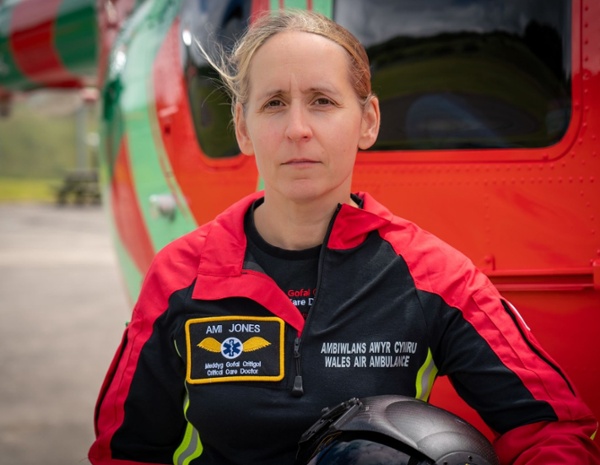
Ami Jones MBE, consultant in intensive care, anaesthetics and pre-hospital, has been with EMRTS Cymru from the very beginning and was instrumental in its establishment.
I joined the army as a reservist in 2009 and did tours of duty in Afghanistan in both 2011 and 2012, which obviously gave me a lot of experience of treating very injured patients on the back of helicopters. When I got back to my civilian job and finished my consultant training lead I thought I shouldn’t waste my military experiences and should try to incorporate this sort of work in my day job.
I hadn’t done any formal pre-hospital training before my experiences with the army, mainly because formal training didn’t exist back then, but I went and joined the Great Western Air Ambulance in Bristol because there wasn’t anything similar where doctors could go on the helicopters in Wales at that time.
It was there I started chatting with another Welsh based doctor, Dindi Gill, the driving force behind EMRTS, and they asked me to get involved in the planning of it with him and a couple of others.
Now we employ more than 200 people but when we started we had skeleton staff so I had lots of roles; mainly the job specs, staff selection and training. Even though there’s lots more people to help with these roles, I’ve maintained oversight of workforce, selection and training and still organise the doctor rotas.
My army training in Sandhurst served me well in terms of understanding and exercising leadership qualities and behaviours. Unfortunately, some people who go into leadership do so as they think it's about what the role can do for them and their development, but the more I have done the more I have realised it’s actually about the people you lead; how you develop them and get them to be the best they can be, which in turn makes your job as a leader more straightforward. I don’t like to micromanage people; overseeing every single task I give them doesn’t allow them to develop. I prefer to point them in the right direction, ensure they understand what the objective is and the left and right of arc of the acceptable way to get tasks done. This allows them to really develop themselves rather than just doing the tasks they are given and often they will find a better or more effective way of getting the work done.
For me, going out and treating patients is the best bit of the job, the easy bit in a way, it’s what we spend a huge amount of our training learning what to do.
I think it's a big jump when you become a new consultant because you've spent 10 to 15 years focusing on yourself and your own development, and suddenly you're in charge of a load of people and actually it's not really about you at all, it's about everybody else and what you can teach them and how you can bring them on.
Like the military, pre-hospital is a very male-dominated environment, but as a woman, you don’t have to act like a man to lead successfully. Women have their own unique way of approaching things, and often cannot rely on physical stature or a loud voice!
There are women in some very good leadership jobs now in both the military and the NHS, and there are plenty coming through the system. This is good news as hopefully we have a steady pipeline of effective, compassionate female leaders who will keep encouraging younger leaders to develop.
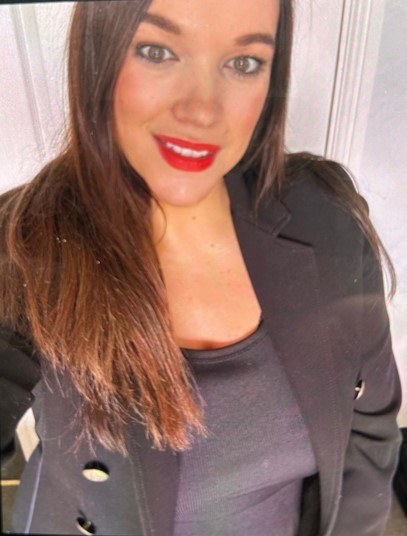
Emma Leese, HR Business Partner
Before joining the NHS in June 2024, my career began in the private sector with organisations such as Virgin Atlantic Airways and Marks & Spencer. Working in fast paced, customer focused environments shaped my early approach to people management—service driven, commercially aware, and grounded in empathy, professionalism, and strong employment law practice.
I later moved into HR consultancy, supporting diverse organisations and eventually running my own consultancy business, where I led and developed other HR consultants. This strengthened my expertise in workforce strategy, organisational change and leadership development, and reinforced the importance of aligning CIPD professional standards and theoretical insight with practical, outcome focused HR solutions.
Transitioning into the NHS felt like a natural next step and an opportunity to apply my experience in a purpose driven setting. As an HR Business Partner, my work is not only about resolving issues—it’s about shaping a sustainable workforce, supporting strategic transformation, and ensuring our decisions create fair, consistent and psychologically safe environments where people can thrive. Every workforce intervention, from policy development to complex employee relations, connects back to system performance and ultimately to the quality of patient care.
My consultancy background enables me to bring clarity and calm into challenging situations, while my CIPD studies continue to guide my ethics, evidence based practice and long term thinking. I am passionate about creating cultures that support accountability, compassion and high standards—cultures where people feel valued and able to contribute their best.
This International Women’s Day, I am proud to celebrate the women across EMRTS and Swansea Bay University Health Board who lead with strength, integrity and authenticity. Their leadership demonstrates that influence isn’t defined by hierarchy or volume—it is defined by fairness, empathy and the ability to lift others as you grow. These women are shaping not only today’s workforce, but the strategic future of our service.
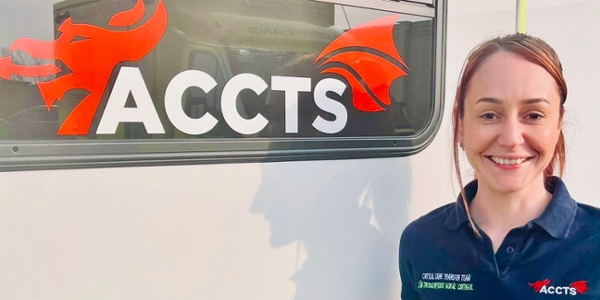
Meryl Jenkins – Lead Practitioner/Service Manager ACCTS Cymru.
From as far back as I can remember, I always wanted to be an ITU nurse. I wanted to be right there in the thick of it, caring for the sickest patients, supporting families in their darkest moments, and being part of a team that makes a difference minute by minute. Even then, I knew that nursing wasn’t just a job; it was a calling.
I qualified as a nurse in 2006 and began my career in ITU in Cardiff before returning home to Glangwili Hospital, where Critical Care truly became my professional home. Over the years I grew from a staff nurse to a junior sister, then a senior ITU Sister, and eventually a senior nurse manager overseeing all the ITUs across the four Hywel Dda sites. I also established the Critical Care Outreach Team and led the education teams across the region. Each role shaped me, stretched me, and taught me something new about what it means to care, and to lead.
I did spend a little time in A&E, but I always found myself drawn back to ITU, like a homing pigeon returning to where I felt most at ease. ITU grounded me. It challenged me. And it pushed me to be better. Of course, COVID tested us all in ways we couldn’t have imagined, but I was privileged to lead a team of 174 incredible people through that time. Their courage and resilience continue to inspire me every day. They reminded me of the strength that lives in ordinary people, when we are faced with extraordinary circumstances.
In 2020, because of my ITU background, I applied to work with ACCTS Cymru. I was intrigued because, in my mind, it felt like ITU… just in an ambulance. What I quickly realised was that you can do extraordinary things in that environment, things we once believed could only happen inside a hospital. And I loved the idea of getting out and about while still delivering critical care. It reminded me that innovation in healthcare isn’t confined to wards and walls.
One thing I’ve learned over the years is that I don’t see myself as a “manager.” I don’t want to simply manage people; I want to lead them. I want to mentor, nurture, and help them grow into confident nurses and practitioners. When you’ve dipped your toes into different aspects of care, you’re better placed to guide others without standing over them.
For me, leadership isn’t about pointing out mistakes, it’s about helping people learn from them. Every challenge is a chance to grow, evolve, and strengthen our practice together. True leadership is creating a space where people feel safe enough to learn, brave enough to try, and supported enough to become the best version of themselves.
That’s why I love ACCTS. We’re bringing innovation into the back of a vehicle. We’re offering patients and staff opportunities that didn’t exist before. We’re enabling transfers that years ago would never have been possible, moving patients safely and compassionately across huge distances, helping families get their loved ones to where they need to be. It’s meaningful work. It matters.
My career so far has taught me that leadership is service. It’s about showing up with compassion, staying grounded in your values, and helping others realise their potential. And as a woman in healthcare, I’m proud to stand here today and say that you don’t need to raise your voice to lead, you just need to lift others up.
On International Women’s Day, I’m reminded that every one of us has a story shaped by courage, resilience, and a desire to make a difference. Mine just happens to be written across ITUs, hospital corridors, ambulances, and countless moments of human connection. We don’t just change teams, we change care, we change systems, and sometimes, we change lives.